Why Everyone is Buying the Hollyland Lark M2S (Full Review)
Introduction: The Wireless Mic Struggle is Real
I still remember the first time I tried to record a professional interview in a crowded downtown coffee shop. I was using a standard shotgun mic on top of my mirrorless camera, and despite my best efforts to position it correctly, the final audio sounded like my subject was speaking from the bottom of a well while a jet engine—actually just a loud espresso machine—roared in the background. That was the day I realized that if I wanted to take my content creation seriously, I couldn't keep relying on "good enough" audio. I needed a wireless system that was discreet, reliable, and, most importantly, didn't make my subjects look like they were wearing a bulky pager from the 1990s.
After months of research and watching every YouTube review under the sun, I finally pulled the trigger on the Hollyland Lark M2S. I’ve been using it for over four months now, taking it everywhere from quiet studio setups to windy outdoor hiking trails. I’ve dropped it, gotten it slightly damp in a sudden drizzle, and pushed its battery life to the absolute limit. What I found was a system that manages to be incredibly simple while delivering audio quality that genuinely surprised me for its price point. In this review, I want to share my honest findings, the tiny details that bothered me, and why I think this specific unit has suddenly become the go-to choice for so many creators.
Design and Build: Small Enough to Forget
The first thing I noticed when I unboxed the Lark M2S was just how tiny the transmitters are. They are roughly the size of a large shirt button. In my experience, one of the biggest hurdles when filming people who aren't used to being on camera is "mic anxiety." When you clip a massive, rectangular transmitter onto someone's collar, they become hyper-aware of the equipment. With the Lark M2S, I’ve had several instances where my subjects actually forgot they were wearing it. I’ve even had to chase a few people down after a shoot because they were about to walk away with the mic still attached to their lapel.
The build quality feels remarkably solid for something so lightweight. The charging case has a satisfying magnetic "thud" when you drop the components back in. However, one thing that bothered me early on was the glossy finish on the transmitter buttons. They look great out of the box, but after a few weeks of real-world use, they become absolute fingerprint magnets. It’s a small gripe, but if you’re a stickler for keeping your gear looking pristine, you’ll find yourself wiping these down constantly.
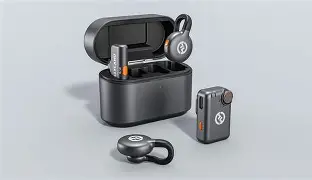
The mounting system is where I think Hollyland really dominated the competition. You get the standard clip-on option, but the magnets are the real stars here. I’ve used the magnet to attach the mic through thick hoodies and even a leather jacket, and it stayed secure. I was initially worried that the magnet might be too weak and the mic would tumble off during a walk-and-talk segment, but after testing it for several miles on a rocky trail, it didn't budge once. That said, I did find that if you're wearing very thin silk or delicate fabrics, the weight of the magnet can cause the fabric to sag a bit, which can look a little awkward on camera.
Audio Performance: Beyond the Marketing Speak
Let’s talk about the actual sound. The Lark M2S records at 48kHz/24-bit, which is essentially the gold standard for high-fidelity video audio. When I first listened to the raw files in my editing suite, I was surprised by the warmth of the vocals. Many budget wireless mics tend to sound "thin" or overly digital, emphasizing the high frequencies in a way that sounds harsh. The Lark M2S has a much more rounded profile. It handles deep voices particularly well, retaining that chesty resonance that makes a speaker sound authoritative.
One feature I was skeptical about was the Environmental Noise Cancellation (ENC). We’ve all used "noise-reducing" tech that makes the voice sound like an underwater robot. I decided to put this to the test by recording next to a busy construction site. What I found was that the ENC is remarkably effective at cutting out low-frequency hums and distant traffic noises. However, it’s not perfect. In my experience, if the ambient noise is too loud or contains sharp, high-pitched sounds (like a siren or a dog barking), the ENC can sometimes "clip" the beginning or end of your words. Now, I generally leave the noise cancellation off unless I'm in a truly disastrous acoustic environment because the natural isolation of a lapel-mounted mic is usually enough.
Shop the latest Cameras & Photography picks on Amazon.
Shop Amazon →The range is another area where I had to do some real-world verification. They claim a 300-meter line-of-sight range. In a wide-open field, I managed to get about 200 meters away before I started hearing any interference, which is way further than I would ever actually need to be from my camera. The real test is the "body block" test—turning your back to the receiver. In a dense urban area with lots of competing Wi-Fi signals, I noticed that if my body was between the transmitter and the receiver at a distance of about 30 meters, I occasionally got a tiny bit of jitter. It didn't ruin the take, but it’s something to be aware of if you plan on doing a lot of movement while filming.
The Comparison: Lark M2S vs. The Competition
To help you understand where this fits in the market, I've put together a comparison based on my testing of the most common alternatives I considered before buying the Hollyland.
| Feature | Hollyland Lark M2S | Standard Clip-On Wireless | …
|---|