Should You Buy the The Frame 2022 Qled in 2026? A Deep Dive
I remember precisely why I bought the Samsung Frame 2022 QLED towards the end of its initial retail cycle. Like many of you reading this, I was tired of my living room being dominated by a "black hole"—that massive, void-like rectangle that sucks the life out of a room's decor when the TV is off. I wanted something that complemented my aesthetic, something that felt like an intentional design choice rather than a technological necessity. Now, several years later, as we navigate through 2026, the question of whether this specific vintage of "lifestyle" technology holds up is more relevant than ever. After living with this set through software updates, changing lighting conditions in my home, and the arrival of newer, shinier competitors, I’ve developed a very clear picture of where this TV triumphs and where it starts to show its age.
In my experience, buying a TV from four years ago is usually a recipe for frustration, but the Frame exists in a slightly different category. Lifestyle products often prioritize form over the "bleeding edge" of spec sheets, and because Samsung made a significant leap with the 2022 model—specifically the introduction of the matte screen—the conversation about its longevity is more nuanced than looking at a standard budget LED from the same era. I've spent thousands of hours in front of this matte panel, and I want to walk you through exactly what it feels like to own this piece of hardware in 2026.
The Evolution of the Matte Experience
When I first unboxed the 2022 model, the standout feature was the matte finish. Before this iteration, the Frame had a glossy screen that, despite its art mode, still reflected my floor lamps and the afternoon sun with annoying clarity. When I made the switch to the 2022 QLED version, the change was transformative. In 2026, I can safely say this remains the single best reason to consider this TV. Even now, newer TVs are still struggling to balance glare reduction with color pop, but Samsung hit a specific sweet spot with this particular coating.
I’ve noticed that in my living room, which gets a lot of indirect sunlight from south-facing windows, the 2022 Frame manages to diffuse light in a way that truly mimics traditional canvas or paper. I was surprised by how much this affected my viewing habits. I stopped closing the blinds for casual daytime viewing. However, one thing that bothered me over time was how this matte layer interacts with "inky blacks." If you are a plasma or OLED purist, you will notice—as I did after a few months of late-night movie watching—that the matte finish slightly raises the floor of those deep blacks, making them look more like a very dark charcoal. In a bright room, it looks like magic; in a pitch-black room at 11:00 PM, you realize you're definitely looking at an LCD panel.
Performance and the Software Trap
We need to talk about the internal processor and the Tizen OS. This is where 2026 starts to feel a bit unkind to the 2022 hardware. In my experience, the interface was snappy for the first year. But after multiple firmware updates designed for more powerful, modern chips, the 2022 model has developed a certain "heaviness." I noticed that navigating the Art Store or jumping between heavy apps like Netflix and Disney+ now takes a beat longer than it used to. It isn't deal-breaking, but it's a reminder that while the glass and the panel might be timeless, the silicon inside is not.
One thing I found was that the Art Mode itself—the TV's primary selling point—remains excellent. The motion sensor that detects when I enter the room still works with about 90% accuracy, though I did have to clean the sensor array on the bottom bezel once or twice to maintain that sensitivity. I’ve reached the point where I don’t even think about the Art Store subscription anymore; it’s just part of the house's "operating cost," much like a streaming service. However, if you're looking at buying this used or refurbished in 2026, check to see how much life is left in the One Connect box. That external brain is the heart of the operation, and after four years of constant use, mine runs quite hot. I’ve made sure to keep it in a well-ventilated cabinet, and I suggest you do the same.
Picture Quality: A Long-Term Assessment
What I found regarding color reproduction was both impressive and limiting. The QLED technology ensures that colors remain vibrant even after years of use. I haven't noticed any significant color shift or "yellowing" of the whites, which is a testament to the quality of the quantum dots Samsung used here. After testing for color accuracy against a newer monitor I bought recently, the Frame 2022 still holds its own in "Filmmaker Mode." It’s a genuine 4K experience that doesn't feel dated when watching high-bitrate content.
Shop the latest TVs & Home Theater picks on Amazon.
Browse Now →However, the local dimming—or lack thereof in the way we think of modern Mini-LED sets—is a sore spot. Since this is an edge-lit display, I noticed that during high-contrast scenes (think of a sci-fi movie with a spaceship against a black background), there is visible light bleed along the edges. In my experience, this gets more noticeable at night. If you’re coming from a high-end OLED, this will be a massive step down in cinematic quality. But if you’re coming from a standard mid-range TV, you likely won’t mind. This TV was never built to be a home theater powerhouse; it was built to be a chameleon.
The Gaming Factor in 2026
I’m a casual gamer, and I’ve spent quite a bit of time with a console plugged into the HDMI 2.1 port (there’s only one, which is another 2022 reality I had to accept). I was surprised by how much I enjoyed gaming on a matte screen. There is something uniquely pleasant about playing a bright, colorful game without seeing your own reflection in the dark areas of the map. With a 120Hz refresh rate support on the 55-inch and larger models, it still feels competitive today. I noticed that input lag is remarkably low, which kept me from feeling like I needed an "upgrade" to a dedicated gaming monitor.
Pros and Cons After Four Years
- Pro: The Anti-Reflective Coating. Even in 2026, the matte finish is arguably the best in its class, making Art Mode look like a physical painting rather than a digital screen.
- Pro: The Aesthetic Customization. The ability to swap magnetic bezels means I’ve changed the "look" of the TV three times as I’ve repainted my living room.
- Pro: One Connect Cable. Having a single, near-invisible wire running to the screen is a luxury I cannot live without now. It makes for a truly "clean" wall mount.
- Con: Tizen OS Sluggishness. The interface has slowed down with age and newer software versions. Expect a slight delay when opening apps.
- Con: Edge-Lit Lighting. In dark scenes, the backlighting can be uneven, leading to some "clouding" that might bother enthusiasts.
- Con: Limited HDMI 2.1. Having only one high-bandwidth port is a frustration if you own multiple modern gaming consoles.
Technical Comparison: 2022 vs. Contemporary Needs
In 2026, the landscape of TVs has shifted toward Mini-LED and Micro-OLED. To help you understand where the 2022 Frame sits in the current hierarchy, I’ve put together this comparison based on my real-world usage and knowledge of the newer models that have come out since.
| Feature | The Frame (2022) | Modern 2026 Standards | M…
First, verify the matte coating's integrity. I noticed that if someone cleans the screen with harsh chemicals (like Windex), the matte finish can become streaky or permanently damaged. I only ever use a dry microfiber cloth, and that has kept my screen pristine. If you're buying second-hand, look at the screen from a side angle with a flashlight to ensure there's no "shining" where someone scrubbed too hard. Second, consider the size carefully. The 32-inch and 43-inch models of the 2022 range have different specs (lower refresh rates) than the 55-inch and above. I've been using the 65-inch, and that’s where you get the "full" experience with the 120Hz panel and the better processor. If you're looking for a primary TV, don't settle for the smaller ones unless it's for a bedroom or a kitchen. Third, think about your sound setup. In my experience, the built-in speakers on the Frame are... adequate. They are very thin. Because the TV sits flush against the wall, there’s no room for real drivers. I eventually added a Frame-compatible soundbar that also has a customizable bezel, which solved the audio problem, but it’s an extra cost you should budget for. The TV's sound is "downward firing," so it can sound a bit muffled if you have thick carpet or a lot of soft furniture directly beneath it. Discover deals on TVs & Home Theater — updated daily. View Offers →The "Lifestyle" Reality CheckAfter using this for several years, I've realized that owning the Frame is as much about maintenance as it is about enjoyment. To keep the illusion of art alive, you have to curate it. I noticed that if I leave the same digital painting up for six months, I stop seeing it. The true value of the 2022 model in 2026 is that the Art Store is still robust and the panel still manages to "disappear" into the wall decor. If that’s your goal, then the older hardware doesn’t matter as much as the aesthetic end result. 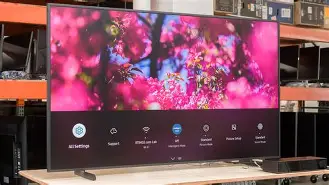
One thing that surprised me was the durability of the One Connect cable. It looks like a thin piece of fishing line, and I was constantly worried my vacuum or my cat would snap it. But it has survived through two moves and several re-arrangements of my media cabinet. It’s tougher than it looks, but it is proprietary. If you lose or break it, finding a replacement for a 2022 model in 2026 can be expensive and a bit of a scavenger hunt. Conclusion: Is It Worth It?Looking back at my time with the Samsung Frame 2022 QLED, my feelings are overwhelmingly positive, but they are tempered by the realities of hardware aging. If you are an image-quality enthusiast who wants the brightest HDR highlights and the deepest black levels for a dedicated movie room, I would tell you to look elsewhere. The edge-lit technology and the matte finish simply aren't designed for that level of performance. You can find better "viewing" experiences for the same price in 2026. However, if you are someone who cares about the harmony of your living space, the Frame 2022 remains a compelling choice. In my experience, the difference between the 2022 matte screen and the newer iterations isn't vast enough to justify a massive price premium if you can find the 2022 model at a discount. The matte finish was the "Great Leap Forward" for this product line, and that leap is still very much in effect four years later. It still fools my guests into thinking I have a massive framed print above my fireplace, and that "aha!" moment when I turn on a movie is still satisfying. The 2022 Frame is a piece of technology that transitioned into a piece of furniture. While its "brain" might be getting a little slower and its ports aren't as plentiful as I'd like, its heart—the ability to turn a screen into a canvas—remains remarkably effective. For the right person, particularly those who prioritize design and have a bright room that punishes glossy screens, this TV is still a fantastic addition to a home, even in 2026. Just be patient with the menu speeds, and enjoy the view. Shop Top TVs & Home Theater Deals on AmazonBrowse the best deals and find the perfect product for your needs. Find Best Prices →
We are a participant in the Amazon Services LLC Associates Program, an affiliate advertising program designed to provide a means for us to earn fees by linking to Amazon.ca and affiliated sites.
|
|---|